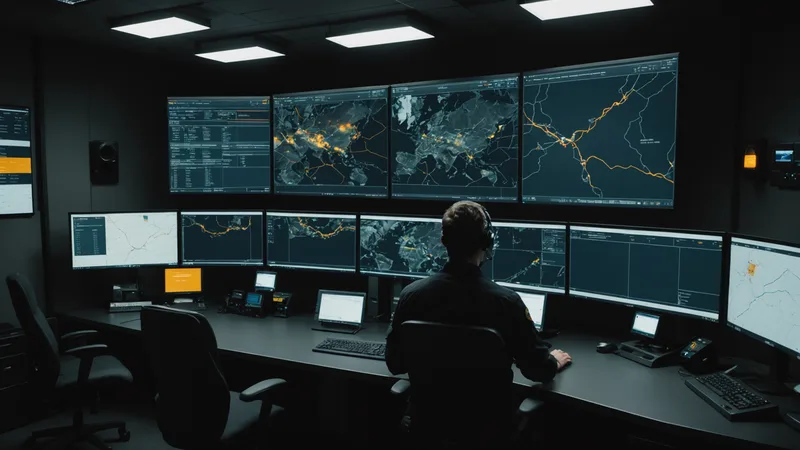
Over the past year, we've done operational walkthroughs with several regional carriers as part of our onboarding process — sitting with the dispatcher from 4:45 AM through the first driver departures at around 7 AM, and then again from 9 to 11 to watch the mid-morning exception handling. We weren't looking for anything in particular going in. What we found was a pattern so consistent across different carriers, different verticals, and different fleet sizes that it stopped feeling like coincidence and started feeling like an industry design problem.
The pattern: dispatchers build meticulous morning plans that are largely accurate at 6:30 AM and partially obsolete by 8:30 AM. The time and effort invested in that morning plan is real. The durability of that plan is not.
A walk through the typical dispatch morning
Most dispatchers at regional carriers in the 15-to-40-vehicle range arrive between 4:30 and 5:15 AM. The first 20-30 minutes are order reconciliation: pulling yesterday's failed deliveries from the TMS, confirming today's order file is complete and loaded, checking for last-minute customer cancellations or add-ons that came in after close of business. This is necessary work and it's done well by experienced dispatchers who know their customer base.
The next 45-60 minutes is route building. This is where the time investment really concentrates. In the dispatchers we watched, route building involved: checking each driver's availability and CDL status against the day's requirements, assigning geographic zones to drivers, running whatever routing tool they have (or manually sequencing stops in a spreadsheet), printing or sending manifests, and doing a final sanity check on anything that looked wrong — a stop with a particularly tight window, a customer known to be difficult, a zone with a known construction issue.
The best dispatchers we watched during this phase were genuinely impressive — holding 20+ routes worth of customer-specific knowledge in their heads, catching errors that the routing software missed, sequencing based on dock schedules and customer relationships that weren't encoded anywhere in the system. This is skilled work.
By 6:30 or 7 AM, drivers are departing with manifests. The dispatcher takes a brief break, handles a few early calls, and then the second phase of the morning begins.
The second phase: reactive firefighting from 8 to 11 AM
Between 8 and 11 AM, in every carrier we walked through, the dispatcher shifted from planning mode to reactive mode. Calls started coming in — drivers reporting problems, customers calling with window changes, dispatch queue issues surfacing as drivers got into their routes. In a 20-vehicle fleet, the volume in this window was typically 12-22 inbound exception calls over 3 hours.
Each one was handled individually: listen to the problem, determine the fix, communicate it to the driver, update the relevant record somewhere (sometimes the TMS, sometimes a personal spreadsheet, sometimes just a mental note). Average call was 4-7 minutes including the resolution steps. Total exception-handling time: 60-130 minutes, depending on how bad the day was.
Here's the number that matters: in three carriers with 18-26 vehicles, the total fully-loaded dispatcher cost for that exception-handling window ran between $280 and $480 per day, when you include the labor cost of the dispatcher plus the cost of the inferior routing outcomes (drivers on routes that weren't re-optimized after exceptions, resulting in extended stops-per-route-hour degradation). The median across those three was close to $400 per operating day.
That's not $400 wasted on careless work — it's $400 spent on reactive management that wouldn't exist if the routes were updating automatically.
The four specific cost drivers
Breaking down where the $400 actually comes from helps understand where the opportunity sits.
Dispatcher exception-call labor accounts for roughly $80-$120. At a dispatcher's loaded hourly rate, 90-120 minutes of exception handling in a 3-hour window is a significant fraction of their productive morning.
Degraded route efficiency from unresolved exceptions accounts for $120-$180. When an exception isn't resolved cleanly — driver proceeds to a stop where the customer is unavailable, sequence doesn't get re-optimized after a window change — you get compounding dead time across the remaining route. Across 18-26 active drivers, even small per-driver degradation adds up quickly.
Failed stops that could have been avoided accounts for $80-$150, at the fully-loaded failed-stop cost of $40-$60 each. In a fleet with 2-4 avoidable failed stops per day — stops that would have been avoidable if the driver had received updated sequence instructions before arriving — this is a real daily cost line.
Missed optimization opportunities accounts for $30-$60. Routes that could have been tightened based on actual first-half-of-day performance data but weren't, because re-sequencing requires dispatcher time that's already consumed by exception handling. This is the subtlest cost and the hardest to see without tracking stops-per-route-hour over time.
What experienced dispatchers are actually solving for
We want to be precise about what we're saying here. The dispatchers doing this work are not doing it inefficiently — they're managing a genuinely complex real-time problem with the tools available to them. The issue isn't dispatcher skill. It's that the problem — keeping 18-26 active routes current against live conditions throughout a 7-hour operating window — is beyond what any single person can manage with manual tools, regardless of experience.
The dispatchers we worked with knew exactly how their morning plan was aging. One operations manager at a produce distributor running 22 vehicles out of a facility off Hamilton Road described it this way: "By 9 AM I know which routes are still close to plan and which ones are already off. I just can't fix all of them because I'm on calls handling the ones that have already broken." That's not a failure of skill — it's a structural capacity problem.
The goal of continuous re-sequencing isn't to replace dispatcher judgment. It's to take the mechanical parts of exception resolution — adjust the sequence for this driver given this window change — off the dispatcher's plate entirely, so they're making the judgment calls (a driver needs to be rerouted to a different zone, a customer situation requires a direct call) without the background load of routine re-sequencing competing for their attention.
Where the $400 number changes
The $400-per-day figure is not universal. It's a reasonable estimate for fleets in the 15-to-30-vehicle range where exception rates are in the normal range (2-4% of stops per day) and dispatcher capacity is the main bottleneck. Smaller fleets with very stable routes and low window complexity will see less — maybe $150-$200. Larger fleets with high window density or multiple verticals can run higher, $500-$700.
The number also changes as your dispatcher gets more help — a second dispatcher, better TMS tooling, pre-built exception protocols. We're not claiming the only solution is route optimization software. We're saying the morning planning / reactive-exception cycle is a structural pattern with real daily cost, and it's worth knowing what that cost is before evaluating any change to your dispatch workflow.
If you want to run the math on your own operation, start with your dispatcher's hourly loaded rate times the minutes spent on exception calls from 8-11 AM over the last week. Add your failed-stop count times your estimated fully-loaded failed-stop cost. Add a rough estimate of how many routes weren't re-sequenced optimally because the dispatcher didn't have time to get to them. That's your baseline — and it tells you what's available to recover.