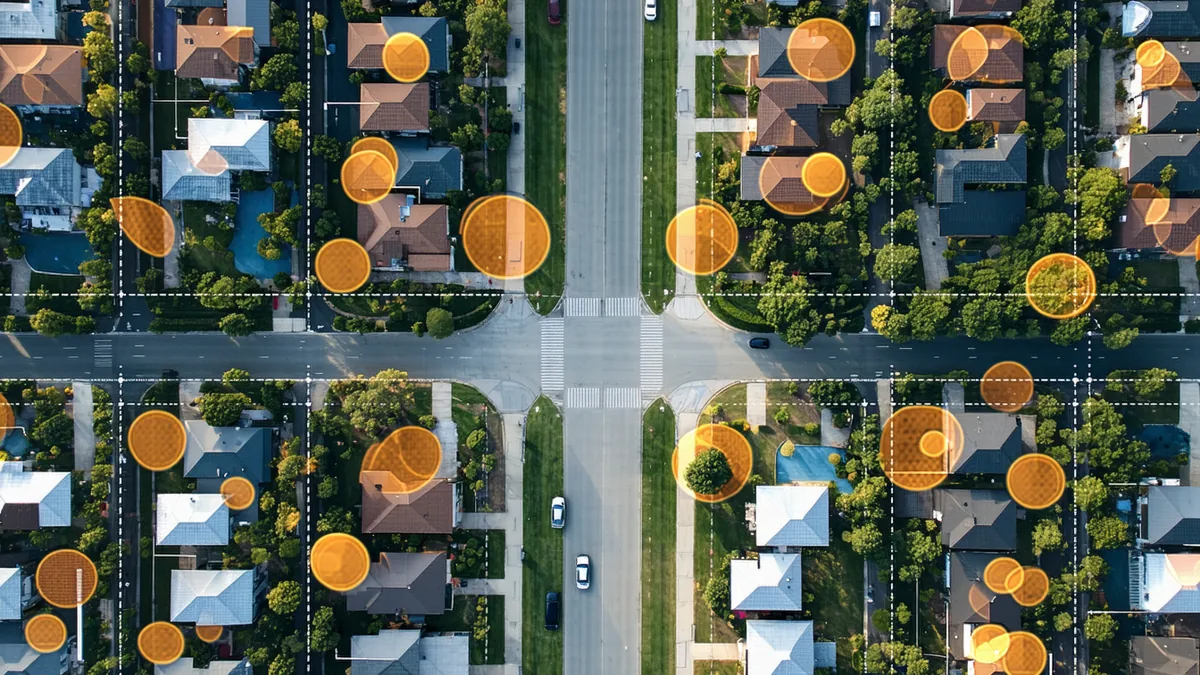
When a driver pulls up to a residential address and no one answers, the assumption is usually that the recipient wasn't home. Often that's accurate. But in a meaningful share of cases, what actually happened is that the timing was wrong — the recipient was home an hour before, or will be home within 90 minutes. The package fails not because the address is inaccessible but because the sequence put it at the wrong point in the route.
Addressing that problem requires knowing something about when residential recipients are likely to be available — not just where they are. That's the function of a residential availability signal layer. This piece explains what those signals are, where they come from, and how routing systems can use them.
What "Residential Availability Signal" Actually Means
Let's start with what it is not. A residential availability signal is not a real-time tracking of where individual people are — that would raise obvious privacy concerns and require data that no routing system legitimately has. It's also not the stated delivery preference a customer provides when booking a shipment ("leave at door" vs. "signature required") — that's a delivery instruction, not an availability prediction.
A residential availability signal is a probabilistic estimate of the likelihood that a recipient will be present and accessible at a given address during a specific time window. That estimate is derived from aggregated, anonymized delivery history data — essentially, what the historical success rate has been for deliveries to this address or this zone type at this time of day on this day of week.
The signal is a pattern, not a real-time feed. Its value comes from the statistical regularity of residential behavior at scale: people in suburban commuter zones are disproportionately absent weekday mornings and present early evenings; households in residential neighborhoods with high work-from-home concentration show different patterns from those in lower-income commuter areas; apartment buildings with doormen have high accessibility regardless of resident availability.
Signal Sources and Signal Quality
The quality and resolution of availability signals depends heavily on data volume. This is exactly where national carriers have a structural advantage over regional operators. UPS, FedEx, and Amazon collectively process hundreds of millions of residential delivery attempts per year. The historical delivery outcome data they've accumulated — success rate by address, by zone, by time-of-day, by day-of-week — gives them signal at a resolution that smaller operators can't match independently.
For a regional carrier running 400–600 stops per day across a defined geographic territory, the historical data volume is much lower. At 500 stops/day × 22 working days × 2 years, you've accumulated roughly 22,000 data points per geographic zone — enough to see meaningful patterns, but not enough to generate address-level predictions with high confidence. Signal at the zip-code zone level is achievable. Address-level signal requires either much more volume or supplementation from other sources.
Signal sources that contribute to practical availability models include:
- Your own historical delivery outcome data — first-attempt success rates by time window and zone, drawn from your TMS or dispatch system records
- Address classification signals — residential vs. commercial, single-family vs. multi-unit, proximity to transit corridors (correlates with commuting patterns)
- Temporal patterns by zone type — working-age residential zones vs. retirement communities vs. student-dense areas each show systematically different availability curves
- Holiday and seasonal adjustments — residential availability shifts meaningfully around school calendar breaks, summer vs. winter patterns, and peak delivery season
How Signals Get Used in Stop Sequencing
The practical application in a routing context is straightforward to describe, though non-trivial to implement. Each stop in a route carries an estimated arrival time — derived from the base sequence and drive time estimates. The availability signal layer assigns each stop a predicted success probability at that estimated arrival time, given the signal data for that address or zone.
Stops that have low predicted availability at their scheduled arrival time become candidates for re-ordering — moved later in the sequence to a window with better predicted availability, subject to the constraint that doing so doesn't violate hard time windows for other stops or make the route infeasible.
The output is a re-sequenced manifest where residential stops with high predicted availability in the early-to-mid route window are grouped toward the front, and stops with better late-day availability are pulled toward the end. Stops with consistently low availability predictions across all windows (apartment buildings with access issues, gated communities without a code on file) are flagged for dispatcher intervention before the route departs.
Signal Confidence and Low-Data Situations
A well-designed availability signal system should be transparent about confidence levels. An address with 200+ historical delivery attempts in your dataset generates a reliable signal. A new address being delivered to for the first time has no address-level signal — the system should fall back to zone-level patterns, and the confidence score should reflect that.
This matters operationally because overconfident predictions on low-data addresses are worse than honest uncertainty. If the system tells a dispatcher that stop 12 has 88% predicted first-attempt success and the dispatcher relies on that, a failure at stop 12 is doubly disruptive — the actual outcome and the false confidence in the prediction. Good signal systems surface confidence intervals, not just point estimates, and dispatcher interfaces should reflect when a prediction is based on thin data.
The Privacy Dimension
Any discussion of residential availability signals needs to address the privacy framing honestly. Pattern-based prediction from aggregated delivery history is categorically different from individual location tracking. The model doesn't know where a specific person is — it knows that, statistically, this zone type at this time of day has historically shown X% first-attempt success rates. That's the same kind of inference a human dispatcher with 5 years of experience in a territory makes intuitively.
The concern worth taking seriously is the combination of availability signals with recipient identity — a system that surfaces "John Smith at 247 Maple Ave is probably home Tuesday mornings" has a different privacy character than one that surfaces "residential stops in Zone 7 have 71% first-attempt success on Tuesday mornings." The routing application is the latter. Keeping it that way matters.
What This Means for Regional Carriers Without National-Scale Data
The honest answer is that regional carriers building their own signal layer from scratch will have lower signal resolution than national carriers for several years. That doesn't mean the approach is worthless — even zone-level availability signals produce meaningful improvement over zero-signal sequencing. And the data compounds: each delivery cycle adds to the historical record, improving signal quality over time.
The more immediate path to useful availability signals for regional operators is leveraging aggregated zone-level models that don't require address-level history — models that encode known behavioral patterns for residential types, commute corridors, and day-of-week availability curves across population segments. These don't require your own 5-year delivery history to be useful; they require accurate zone classification and a feedback loop that refines estimates based on your actual outcomes over time.
The value of availability signals isn't that they're perfect predictors. They're probabilistic estimates — and even imperfect estimates, systematically applied across hundreds of residential stops per day, can shift enough attempts into higher-probability windows to meaningfully reduce the re-delivery rate. That's the operational bet the signal layer makes.