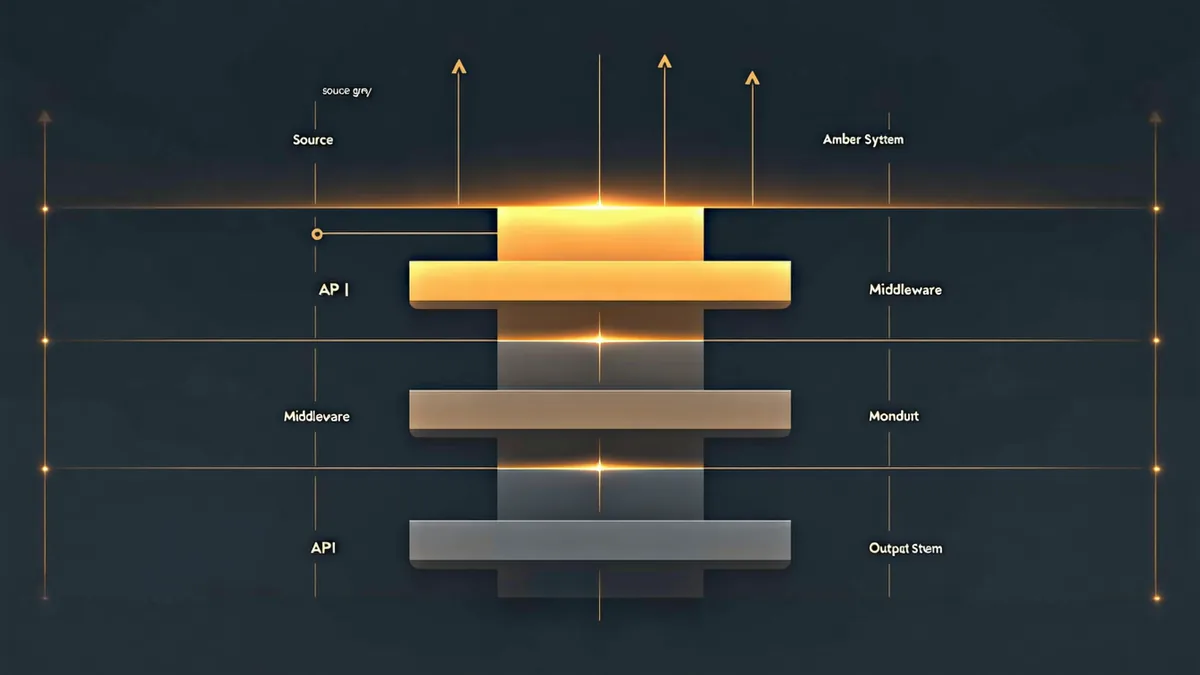
Five years ago, the standard approach for a regional carrier that wanted better routing intelligence was a software replacement project. Rip out the existing TMS, implement a new platform with built-in route optimization, spend six months migrating, train dispatchers on a new system, and hope the improved routing logic justified the disruption. Most carriers didn't do it — the risk was too high and the operational disruption too costly for incremental routing improvement.
The architecture shift that's happened since is significant. Routing intelligence is increasingly available as a composable API service — a layer you call from your existing system rather than a system you replace your existing stack with. For regional carriers, this means that sophisticated sequencing capabilities are now reachable without a platform migration. The stack evolution is worth understanding in detail, because it changes the viable options considerably.
The Problem with Monolithic Routing Platforms
Traditional routing software architectures are monolithic: the TMS, route optimization engine, driver dispatch interface, and delivery tracking all live in one system. This made sense when integration was hard and APIs were not standardized — if everything is in one system, you don't need to worry about making systems talk to each other.
The cost of monolithic architecture is flexibility. When your optimization requirements change — you need availability-signal sequencing, or a new type of zone management, or a different time-window constraint model — you're dependent on your platform vendor's roadmap. If they don't build it, you either live without it or go through another platform migration.
For regional carriers who run 15–80 daily routes, the monolithic platform's full feature set is also often unnecessary and expensive. You need vehicle assignment and capacity management, time-window compliance, and increasingly, availability-aware sequencing for residential stops. You don't necessarily need enterprise fleet telemetry, multi-country compliance modules, or warehouse management system integration. Paying for the whole platform to access the parts you need is a poor value equation at regional scale.
What API-First Middleware Actually Looks Like
The API-first architecture inverts this. Your existing TMS stays in place — it handles vehicle assignment, driver dispatch, POD capture, and customer records. The routing intelligence is consumed as an API service: your system sends a stop manifest to the routing endpoint and receives a sequenced manifest in response. The two systems communicate over a well-defined interface; neither needs to know how the other works internally.
For a stop-sequencing use case, the data contract is narrow and stable:
// Request: planned stops with time constraints
POST /v1/sequence
Authorization: Bearer {api_key}
Content-Type: application/json

{
  "route_id": "RT-20260115-042",
  "depot": { "lat": 39.9612, "lng": -82.9988 },
  "vehicle": { "capacity_kg": 800, "type": "cargo_van" },
  "stops": [
    {
      "id": "S-0041",
      "address": "1842 Elmwood Ave, Columbus OH 43209",
      "time_window": { "start": "08:00", "end": "18:00" },
      "service_minutes": 3,
      "weight_kg": 1.8,
      "type": "residential"
    },
    {
      "id": "S-0042",
      "address": "375 Commerce Pkwy, Westerville OH 43081",
      "time_window": { "start": "10:00", "end": "14:00" },
      "service_minutes": 8,
      "weight_kg": 12.4,
      "type": "commercial"
    }
  ]
}

// Response: re-sequenced stops with scores
{
  "route_id": "RT-20260115-042",
  "processing_ms": 847,
  "stops": [
    {
      "id": "S-0042",
      "sequence_position": 1,
      "estimated_arrival": "10:22",
      "availability_score": 0.94,
      "score_basis": "commercial_receiving_hours"
    },
    {
      "id": "S-0041",
      "sequence_position": 2,
      "estimated_arrival": "11:05",
      "availability_score": 0.71,
      "score_basis": "zone_pattern_tuesday"
    }
  ]
}
The TMS receives this response, updates the driver manifest with the re-sequenced order and estimated arrival times, and the driver's app reflects the updated sequence. From the driver's perspective, nothing changed about the interface — they see the same manifest UI, just with a different stop order. From the dispatcher's perspective, the manifest shows availability scores per stop, which surfaces high-risk stops for proactive intervention.
The Middleware Adapter Layer
In practice, most regional carrier TMS platforms don't have a clean REST API for reading and writing route manifests. They were built for an era when internal data was exported as CSV files and re-imported — not consumed programmatically. This is where the middleware adapter comes in.
The adapter is a thin service — typically 200–500 lines of code — that handles format translation. On the TMS side, it reads the daily route export in whatever format the TMS produces (CSV, proprietary XML, fixed-width text — the variety is real). On the routing API side, it translates that data into the API's expected JSON format, calls the endpoint, and translates the response back into the format the TMS expects for re-import. It handles authentication, retries on transient errors, and logs outcomes for debugging.
Building this adapter correctly is the primary integration effort. The routing API side is straightforward — modern API services have good documentation and consistent contracts. The TMS side requires understanding the TMS's export schema (which is often incompletely documented) and the re-import validation rules (which have edge cases that only surface in testing).
An important design principle: the adapter should fail gracefully. If the routing API is unavailable or returns an error, the adapter should pass through the original unsequenced manifest to the TMS rather than blocking dispatch. The routing layer is an enhancement; it should never be a single point of failure for operations.
Latency and the Planning Window
A common concern when evaluating API-first routing: latency. If the sequencing call takes 60 seconds for a 35-stop route, does that disrupt the dispatch workflow?
For the majority of regional carrier dispatch workflows, the answer is no — because the sequencing call happens during the route build window (typically the evening before or early morning before departure), not in real time during dispatch. Routes are built several hours before drivers depart. Adding 60–90 seconds to the route finalization process is not materially disruptive.
Where latency matters is mid-route re-sequencing — if a driver wants an updated sequence for remaining stops based on completed deliveries so far. This is a more demanding latency requirement (sub-30 seconds, ideally sub-15) and requires that the driver app can trigger and display a re-sequencing result in real time. Achievable, but it requires more investment in the driver app integration than the planning-window use case.
When API-First Middleware Is the Right Architecture
API-first routing middleware makes the most sense when: your existing TMS is functional for vehicle assignment and dispatch management; you need routing intelligence that your TMS doesn't provide natively; and you want to avoid platform migration risk. It's also the right architecture when your routing requirements may evolve — because the API layer can be swapped or upgraded without touching the TMS.
It's not the right architecture when your TMS is fundamentally inadequate for your dispatch scale and you need a full-stack platform replacement anyway. In that case, selecting a platform that includes good routing optimization is more efficient than replacing the TMS and adding a routing middleware layer separately.
For most regional carriers who have functional TMS infrastructure and primarily need to add availability-aware sequencing on top of their existing route management workflow, the middleware layer is the faster, lower-risk path to capability improvement — and increasingly, it's the architecture that advanced routing capabilities are designed to support.